Kabbalistic Tarot and Your Natal Energetic Signature
Frater Lucis · 8 January 2026
Beyond Surface-Level Meanings
Let's be honest about what most tarot readings look like: You shuffle, pull a few cards, consult your memorised keywords or a guidebook, and offer interpretations that sound plausible but often feel generic. "The Three of Cups means celebration... you'll experience joy with friends." "The Tower means sudden change... expect disruption in your life." These aren't wrong, exactly, but they're shallow. They're describing what without understanding the perspective through which the meaning is being interpreted. That perspective is the position that card belongs to in the Tree of Life.
Here's what changes when you read through the Kabbalistic framework:
Traditional tarot reading: Card meanings as isolated symbols.
Kabbalistic tarot reading: Cards as coordinates on a map of consciousness.
Traditional: The Three of Cups appeared, so expect celebration.
Kabbalistic: Binah is expressing through Briah—your soul has created a stable emotional container capable of holding joy. The celebration isn't random; it's the natural result of understanding (Binah) manifesting in the emotional realm (Briah). This shifts it from being surface-level happiness to soul-level recognition because you understand all the aspects that have made you happy. It means you are genuinely seeing the world around you.
See the precision? You're not making vague predictions but rather diagnosing the architecture of what's happening in the querent's consciousness, and showing them why their experience has the exact quality it does. Let me give you more examples so you can see how this works in practice.
Example 1: Why "Positive" Cards Can Reveal Problems
Card pulled: Ten of Cups
Traditional interpretation:
"Great news! The Ten of Cups is one of the best cards in the deck. It means emotional fulfilment, happy family, lasting love. You're heading toward your happily ever after."
Kabbalistic interpretation:
"The Ten of Cups shows Malkuth fully manifested in Briah—your emotional reality has completed its cycle and crystallised into physical form. This is lasting love, yes, but Tens are endings. Malkuth is the final Sephirah, where energy stops descending and becomes fixed. This card asks: Is this emotional completion what you truly want, or have you settled into a pattern that feels safe but limits growth? Tens bring stability, but they can also bring stagnation. What comes after completion?"
The difference:
A traditional reader might miss the subtle warning in the Ten of Cups if the querent is already feeling restless in a "perfect" relationship. The Kabbalistic reader recognises that Malkuth's completion can feel like a cage if the soul is ready for a new Ace, a new cycle of growth. You're reading the structure of the card, not just its symbolic association with happiness.
Example 2: Reading the "Negative" Cards with Nuance
Card pulled: Five of Swords
Traditional interpretation:
"The Five of Swords means conflict, defeat, someone might betray you. Be careful of people trying to win at your expense. This is a warning card."
Kabbalistic interpretation:
"The Five of Swords is Geburah expressing through Yetzirah—severity in the mental realm. This isn't about external betrayal; it's about how your thoughts are cutting you off from the truth. Geburah's function is to destroy what doesn't serve, and in Yetzirah (the world of mental constructs), that means your belief systems are being challenged. The 'defeat' here is actually your ego's attachment to being right. The card is asking: What mental battle are you fighting that you need to lose? What would you gain by surrendering your need to win this argument—with others or with yourself?"
The difference:
A traditional reader might advise the querent to be defensive, to protect themselves from scheming people. The Kabbalistic reader recognises that Geburah in Yetzirah is an internal process—the mind destroying its own illusions. The "enemy" in the Five of Swords is often your own thoughts, not an external person. This reading points the querent toward liberation, not paranoia.
Example 3: Understanding Why Cards Appear Together
Three-card spread: Two of Pentacles + Ace of Cups + Seven of Wands
Traditional interpretation:
"You're juggling responsibilities (Two of Pentacles), but new love is coming (Ace of Cups), and you'll need to defend your boundaries (Seven of Wands). Stay balanced, be open to romance, and stand your ground."
Kabbalistic interpretation:
Let's trace the energy through the worlds:
Two of Pentacles (Chokmah in Assiah):
You're experiencing duality in the material realm—Chokmah's dynamic force trying to manifest physically, but not yet stable. Resources are in motion; adaptation is required. This is raw creative energy landing in practical reality, but without form yet.
Ace of Cups (Kether in Briah):
Meanwhile, divine grace is arriving in your emotional world—Kether descending into Briah means you're being offered a soul-level opening, a gift of emotional connection or spiritual love. This isn't something you created through the juggling; it's arriving despite the chaos.
Seven of Wands (Netzach in Atziluth):
Your spiritual vision requires defence—Netzach (desire, instinct) expressing through Atziluth (divine will) means your creative calling is under pressure. You're being forced to clarify what you truly want at the spiritual level, to separate authentic vision from external expectations.
The pattern:
Material instability (Assiah) → Emotional grace arriving (Briah) → Spiritual conviction being tested (Atziluth).
The narrative:
"Your practical life is in flux because you haven't yet stabilised Chokmah's creative force into material form—you're adapting, which is exhausting. But while you're busy juggling, grace is arriving in your emotional world as Kether's gift. You didn't earn this—it's being offered. The challenge is that your spiritual vision (Seven of Wands) is being tested. Can you receive this emotional gift while defending your deeper calling? The instability in Assiah is actually preparing you to say yes to what's arriving in Briah, but only if you're clear about what you're defending in Atziluth. What do you truly want at the soul level? That clarity will stabilise everything else."
The difference:
Traditional reading treats these as three separate events. Kabbalistic reading reveals the causal chain—how energy is moving through worlds, where it's blocked, and what needs to happen for integration. You're not just predicting; you're diagnosing and prescribing.
The Natal Energetic Signature System
Up to this point, we have explored Tarot through a Kabbalistic lens — not as fortune-telling, but as a symbolic language capable of revealing how divine order expresses itself through the human psyche.
Traditional Kabbalistic Tarot maps the cards onto the Tree of Life, offering a profound structural framework for interpretation. The Tree, however, is architectural rather than situational. Its pathways and correspondences describe how divine energy flows, but not where an individual stands within that flow at a given moment.
This is the gap the ancient mystics were always trying to bridge.
Before the rise of Kabbalah as a contemplative system, Israelite priesthood possessed a direct means of situational divine inquiry. After its disappearance, Kabbalists were left to reconstruct orientation through letters, numbers, sefiroth, and angelic intelligences. What emerged was not static doctrine, but an ongoing attempt to answer a living question:
How does divine emanation meet this soul, in this life, at this time?
The Natal Energetic Signature System is my response to that same question, expressed through a modern symbolic interface.
Rather than treating the Tree of Life as a fixed diagram applied uniformly to all people, this methodology introduces personal orientation into the reading. Using the moment of birth as a point of emanatory imprint, it identifies the angelic and energetic patterns through which a person’s life force initially descends into form. These patterns do not determine fate, nor do they replace the Tarot — they provide context.
In practice, the Natal Energetic Signature functions as an orienting lens. It clarifies which currents are native to the soul, where tension or coherence tends to arise, and how external transits interact with an individual’s inner architecture. When combined with Tarot, the reading no longer floats abstractly on the Tree, but becomes grounded in the lived structure of the person receiving it.
This is not an attempt to predict the future or reduce the soul to data. It is a diagnostic tool — one that restores a principle shared by the earliest mystical traditions: divine insight must be situated to be useful.
Tarot reveals what is active and a querents Natal Energetic Signature reveals how their psyche is likely to receive that info. Together, they allow a reading to move from symbolism into alignment — from insight into action.
How it Works in Practice
Step 1: The Birth Moment as an Emanatory Imprint
At the moment of birth, a person enters the world through a specific configuration of planetary forces. In conventional astrology, this is represented as a two-dimensional natal chart. In the Natal Energetic Signature system, that same information is translated onto the Tree of Life, treating the birth moment not as a prediction of fate, but as an initial pattern of emanation.
Each planet corresponds to a Sephirah by function — not as a personality label, but as a mode of consciousness through which divine influence is received:
Sun → Tiphereth – integration, vitality, coherent selfhood
Moon → Yesod – astral interface, subconscious patterning, emotional memory
Mercury → Hod – intellect, language, symbolic ordering
Venus → Netzach – desire, attraction, continuity of feeling
Mars → Geburah – will, force, separation, decisive action
Jupiter → Chesed – expansion, order, beneficence, governance
Saturn → Binah – structure, limitation, discernment, containment
Rather than stopping at these correspondences, the system also considers where each planet falls by degree, identifying which pathways of the Tree (reflected in the Major Arcana) are illuminated at birth. The result is not a static diagram, but a pattern of emphasis — showing which Sephiroth are naturally active, which are quieter, and how consciousness tends to move between them.
Your natal chart, in this sense, becomes a map of orientation, not destiny: a record of how divine influence first entered form through you.
Step 2: Distribution Across the Four Worlds
Emanation does not express itself in a single register. It descends through the Four Worlds, each governing a different level of experience. The Natal Energetic Signature evaluates how your birth pattern distributes energy across these worlds:
Atziluth (Fire signs) – spiritual will, creative impulse, archetypal identity
Briah (Water signs) – emotional depth, soul bonds, relational patterns
Yetzirah (Air signs) – thought, perception, communication, mental structure
Assiah (Earth signs) – embodiment, material life, practical consequence
Most people show clear imbalances. A chart heavy in Atziluth but weak in Assiah often belongs to someone rich in vision but poor in follow-through. Strong Assiah with little Briah may produce outward success accompanied by emotional disconnection.
The Signature does not judge these patterns — it reveals where energy flows easily and where conscious cultivation is required. This allows a reading to move beyond vague advice and into practical alignment.
Step 3: Transits as Active Emanations
The natal pattern establishes a baseline, but life unfolds through activation. As planets continue to move, they periodically engage with the natal structure, illuminating different Sephiroth and pathways over time.
For example:
When transiting Jupiter engages the natal Sun, the Chesed–Tiphareth axis is activated — expansion meeting identity, growth challenging integration. In a reading during such a period, symbols connected to those Sephiroth and their paths naturally rise to the surface, because that dialogue is already active in the person’s consciousness.
When transiting Saturn challenges natal Venus, Binah presses against Netzach — structure tests desire, limits refine attraction. The reading then explores how this tension expresses itself emotionally (Briah), mentally (Yetzirah), and materially (Assiah).
Rather than simply noting astrological events, the Natal Energetic Signature identifies which parts of the Tree are in conversation, and how that conversation echoes across the Four Worlds. The Tarot becomes a mirror of that activation, not a separate or competing system.
Step 4: Tarot as Diagnostic Revelation
When Tarot is integrated with the Natal Energetic Signature, the cards are no longer read in isolation. They function as a diagnostic language, revealing how the emanatory structure is currently being experienced.
If a Signature shows weak Briah activation, and a reading repeatedly produces Sword cards (Yetzirah), this confirms an over-identification with thought at the expense of feeling. The cards are not predicting this state — they are revealing what is already present, so it can be consciously addressed.
This is why the readings feel precise rather than speculative. The Tarot is not guessing; it is translating. Multiple systems — astronomy, Kabbalah, and symbolic imagery — converge on the same pattern from different angles, each confirming the others.
The result is clarity, not mystique: a way of seeing where the soul stands within the flow of emanation, and how to act in alignment with it.
What Makes This Different
To understand what sets the Natal Energetic Signature system apart, it helps to be clear about what most approaches are actually doing.
Standard tarot reading relies on cards pulled and intuitively interpreted. Insight can emerge, but there is no structural explanation for why these cards appeared, or what deeper pattern they reveal. The guidance is often resonant, but rarely anchored.
Astrological tarot attempts to improve this by linking cards to planets or zodiac signs, sometimes incorporating birth chart information. This adds context, but astrology and tarot remain separate systems, loosely correlated rather than truly integrated.
Traditional Kabbalistic tarot goes further. Cards are mapped onto the Tree of Life, and readings reveal the structure of consciousness itself. This is powerful work — but it is also static. The Tree does not change, and most readings do not account for how planetary movements activate different parts of that structure over time.
The Natal Energetic Signature system integrates all three into a single, coherent method:
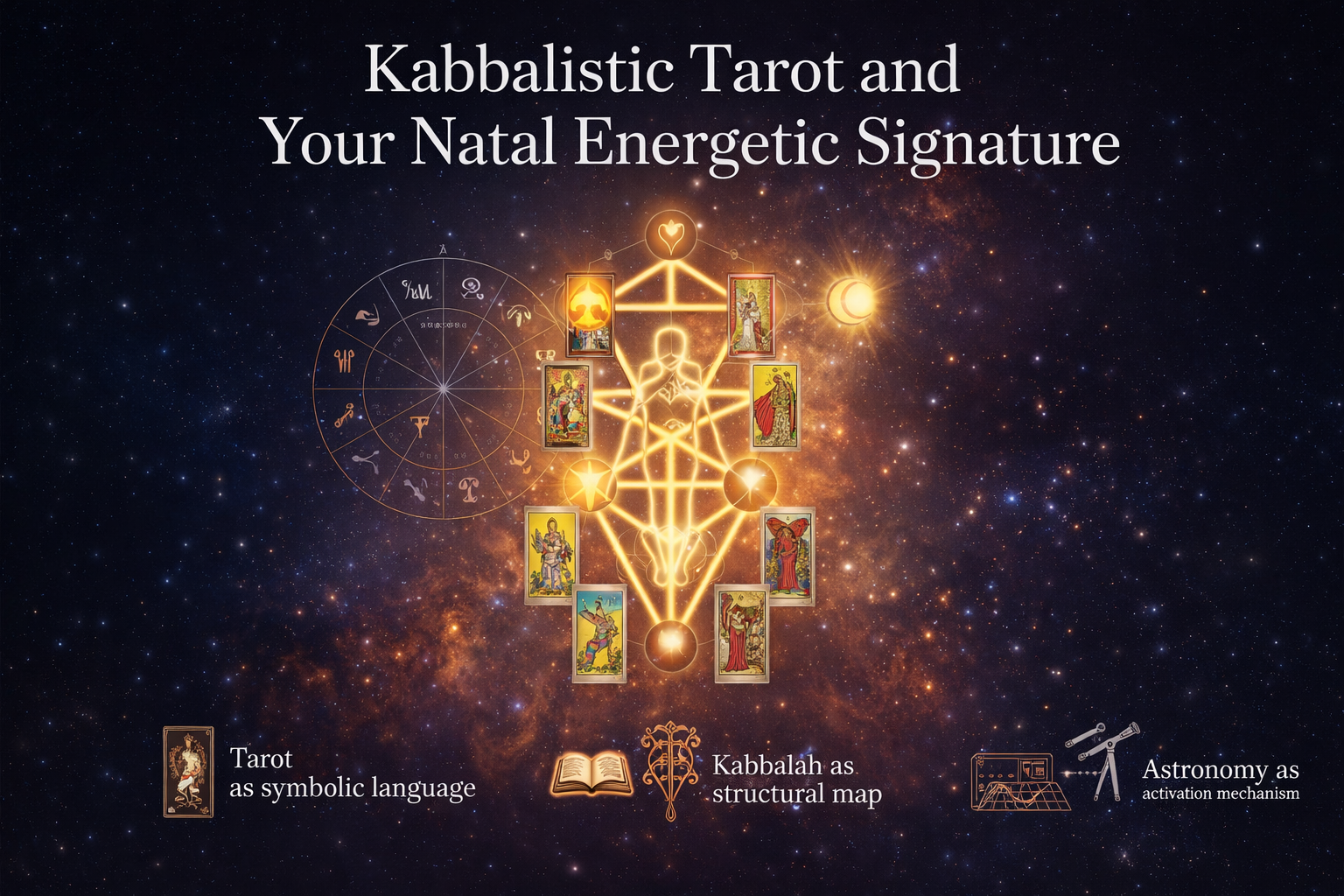
Tarot provides the symbolic language
Kabbalah provides the structural framework (the Tree of Life, the Four Worlds, the Sephiroth)
Astronomy provides the activation mechanism (the natal imprint and ongoing transits)
The result is a reading that is:
Personally specific — rooted in your unique natal pattern
Structurally precise — grounded in Kabbalistic architecture
Dynamically accurate — reflecting what is activated now, not in theory
Practically actionable — revealing where energy is flowing, blocked, or shifting in real time
This is not fortune-telling. It is consciousness mapping — using three ancient systems that describe the same reality from different perspectives, synthesised into a single diagnostic tool.
Why Tarot Alone Isn’t Enough
Tarot on its own, however intuitive, lacks the precision required for consistent transformation. Skilled readers can access profound insights through the cards, but without a framework there is no reliable way to explain why a particular message emerged or how it fits into the larger structure of the person’s life.
The result is inconsistency. Sometimes the reading lands perfectly; sometimes it misses. Often the querent leaves inspired, but without a clear understanding of how their consciousness is organised or what needs to change.
The Kabbalistic framework provides that missing map. It transforms tarot from a purely intuitive art into a diagnostic practice — without stripping away intuition. Precision and intuition are not opposites; they are complementary.
When real-time astronomical activations are added — revealing which parts of the Tree are active now for this specific individual — the work moves beyond even traditional Kabbalistic Tarot. It becomes personally tailored, structurally grounded, and responsive to the actual energetic conditions of this moment in a person’s life.
This is what I mean when I say I’ve created an alternative to astrology. I’m not rejecting astrology; I’m translating its precision through the Tree of Life and expressing it through tarot’s symbolic richness.
The result is a synthesis that is:
more accessible than traditional astrology,
more precise than intuitive tarot,
and more alive than static Kabbalah.
It doesn’t replace these systems, but rather creates a much more aligned picture.
Read Part 5